
How to Communicate With Confidence and Executive Presence
Stacey Hanke, CPAE Hall of Fame Keynote Speaker and Communications Expert
You know your material, have the experience and the title. Still, you may walk into an executive meeting and rush your recommendation, overexplain when challenged or fill every pause because the silence feels uncomfortable.
You may feel confident, yet your listeners may experience something different.
That matters because executive presence is not determined by how confident you feel. It is determined by what people consistently experience when you communicate.
Executive presence is the ability to communicate in ways that cause others to experience you as confident, credible, composed and worth listening to. It is built through observable verbal, vocal and visual behaviors that can be identified, practiced and improved.
You are not simply born with executive presence. You build it Monday to Monday®.
What Is Executive Presence?
Executive presence is often treated like an elusive quality. Someone walks into a room and people pay attention. They seem confident without being loud, speak with clarity and remain composed when challenged.
It is tempting to call that charisma, but that explanation is not very useful. If executive presence were simply personality or something you were born with, there would be little you could do to improve it.
That has not been my experience working with executives and leaders.
Executive presence becomes much more practical when you stop treating it like a personality trait and start looking at the behaviors underneath it.
Your listeners experience:
The words you choose
How quickly you get to the point
The sound of your voice
Your pace and pauses
Where you look
How you move
Whether you listen
How you respond when challenged
Whether your behavior changes depending on who is in the room
Those behaviors shape whether people perceive you as confident and credible.
Executive presence is not a performance. It is a behavioral pattern.
The Executive Presence Mistake: Judging Yourself by How You Feel
One of the biggest obstacles to stronger executive presence is relying too heavily on your intentions.
You know what you meant. Your listeners only know what they heard, saw and experienced.
You may feel prepared because you know the subject well, while your listener experiences you as unprepared because it takes five minutes to understand your point. You may feel enthusiastic, while they hear a flat voice and see little facial expression. You may feel confident, while they watch your eyes move around the room and hear your rate of speech increase.
This is the gap leaders need to pay attention to: the difference between how you believe you show up and how others experience you.
A 2024 peer-reviewed study on leader-follower perception involving 160 leader-follower pairs examined agreement between leaders' self-ratings and followers' ratings of transformational leadership. The research reinforces a broader body of work showing that leaders and followers do not always experience leadership behavior the same way.
That does not mean every difference in perception signals poor leadership. It does mean your self-assessment cannot be your only source of information.
Instead of asking only, “How did I feel?” ask, “What did my listeners experience?”
Confidence Is Not the Same as Credibility
Confidence and credibility are closely connected, but they are not the same thing.
Confidence shows up in how decisively you communicate. Credibility is earned when people have a reason to believe what you say and trust how you show up.
You can sound confident and still lack credibility. You can also feel nervous while communicating in a way that listeners experience as calm, clear and credible.
This distinction matters because leaders often chase the feeling of confidence. They tell themselves they need to stop being nervous, feel more powerful or believe in themselves more before an important meeting.
Those thoughts may help, but they do not identify the behavior that needs to change.
A more useful question is:
What am I doing that causes people to experience confidence or doubt?
A 2025 study published in the Journal of Speech, Language, and Hearing Research examined how vocal cues affected credibility judgments. Fifty-two participants evaluated speakers using semantically neutral statements with manipulated vocal cues, and higher perceived vocal confidence influenced credibility judgments.
The study does not prove that a certain voice automatically makes someone credible. Its sample was small and the experiment was conducted under controlled conditions. It does, however, reinforce an important point: listeners respond to more than your words.
Instead of trying to “be more confident,” identify what confidence sounds and looks like.
Executive Presence Is Verbal, Vocal and Visual
When I coach leaders, I want executive presence to become something they can observe.
Three categories make that easier:
Verbal
Vocal
Visual
You need all three because a powerful message delivered with distracting behavior loses impact. Strong body language cannot rescue a message that never reaches the point, and a confident voice cannot compensate for poor listening.
Your words, voice and physical behavior work together to create the experience people have with you.
Verbal Behaviors That Strengthen Executive Presence
Executive presence starts with what you say, not how much you know.
Get to the point
Executives often weaken their presence by giving too much information before reaching the recommendation. They provide the history, background, analysis and caveats before telling the listener what they actually think should happen.
Eventually, someone has to ask:
“What are you recommending?”
That should not happen.
Instead of:
“I’ve been looking at several options over the last few weeks, and there are advantages and disadvantages to each one. I know there are different opinions about this. What I was thinking we might want to consider is...”
Try:
“My recommendation is Option B. Here are the two reasons.”
Clear language communicates control.
Remove unnecessary qualifiers
Pay attention to phrases such as:
I think maybe
I’m not sure, but
I just wanted to
This might be a bad idea
I could be wrong
I was kind of thinking
There are times when uncertainty should be acknowledged. You do not, however, need to weaken every recommendation before making it.
Instead of:
“I was kind of thinking maybe we should delay the rollout.”
Try:
“I recommend delaying the rollout until the customer testing is complete.”
Your listener can disagree, but at least they know what you believe should happen.
Make the next step obvious
Executive presence is not simply sounding polished. Influence requires movement.
Before you finish an important conversation, make sure listeners understand:
What was decided
Who owns the next step
What happens next
When it will happen
If people leave impressed by you but unclear about what to do, your communication did not create enough influence.
Vocal Behaviors That Communicate Confidence
People often hear confidence before they analyze every word, which is why vocal behavior deserves attention.
Slow down when pressure increases
Many leaders do the opposite. Someone challenges them and they speed up, explain more and lose control of their pacing.
Even when they know the material, listeners may experience anxiety or uncertainty.
A faster rate is not automatically a problem. The issue begins when your pace controls you rather than the other way around.
Slow down enough to give listeners time to process what you are saying.
Pause with purpose
Silence can feel uncomfortable when you are the one speaking, but listeners usually experience it differently.
Pause:
Before an important recommendation
After making a key point
Before answering a difficult question
When transitioning to a new idea
When you need a moment to think
A strategic pause gives listeners time to absorb the message and helps prevent filler language from taking over.
Pay attention to vocal conviction
Listen to what happens at the end of your sentences.
Does your statement sound like a question? Does your volume disappear? Does your energy drop when you reach the recommendation?
Record yourself during a real conversation and listen without watching the video. Ask:
Do I sound certain when I am certain?
Does my voice support the meaning of my words?
Where does my energy change?
Do I use filler words when I am thinking?
Would I want to continue listening?
You may be surprised by what you hear.
Visual Behaviors That Strengthen Executive Presence
Your listeners are watching while they listen, yet many leaders have no idea what they are doing physically while communicating.
That is where executive-presence blind spots often become obvious.
Make eye connection
Eye connection is not staring. It is staying connected to someone long enough to complete a thought.
When you repeatedly look away while speaking, listeners may perceive distraction, discomfort or uncertainty. When you make a key point, let your eyes support it and finish the thought before looking elsewhere.
Stop unnecessary movement
Some movement is purposeful. Some is simply nervous energy.
Common distractions include:
Rocking
Pacing
Shifting from side to side
Playing with a pen
Touching your hair
Adjusting clothing
Moving your hands without purpose
The goal is not to become motionless. It is to make sure your movement supports your message instead of competing with it.
Sometimes the most powerful behavior is stillness.
Gesture intentionally
Purposeful gestures can reinforce a message, while constant movement becomes visual noise.
Use gestures when they help you:
Emphasize an important point
Compare two options
Indicate size or direction
Reinforce a transition
Then let your hands rest.
You do not need constant movement to maintain attention.
Executive Presence Shows Up Under Pressure
Almost anyone can appear composed when everything is going well. Pressure reveals habits.
Someone challenges your recommendation. An executive interrupts you. A customer becomes skeptical. The board asks an unexpected question, or an employee disagrees with you publicly.
Your response becomes part of your executive presence.
Instead of immediately defending yourself, pause long enough to hear the full question. Clarify what you heard if necessary, then respond.
Compare these reactions.
Reactive:
“That’s not really what I was saying. What I meant was...”
More composed:
“That’s a fair concern. Let me clarify the recommendation.”
Or:
Reactive:
“I already explained why we can’t do that.”
More composed:
“I hear the concern. The constraint we still need to work within is...”
Composure is not about avoiding difficult conversations. It is about staying in control of your communication while you have them.
Your Title Does Not Create Executive Presence
A title gives you authority, not automatic influence.
People may comply because you are the CEO, vice president or senior leader. That is different from choosing to trust your judgment and act on your recommendation.
Ask yourself:
If my title disappeared tomorrow, would people still choose to follow me?
2026 research on leader credibility makes a useful distinction between credibility attached to the individual and credibility attached to the leadership position. Personal leader credibility is shaped in part by followers' perceptions of consistency between a leader's words and actions.
Your title may open the door, but your behavior determines what happens next.
For a deeper look at the behaviors that make leaders believable over time, see How Leaders Build Trust Through Clear, Credible Communication.
Executive Presence Is Built Monday to Monday®
One of the biggest mistakes leaders make is turning executive presence on only when the stakes feel high.
They prepare carefully for the board meeting, keynote, investor presentation, customer pitch or important interview. Then they rush through a conversation with a team member, send a confusing email, arrive late to the next call or look at their phone while someone is speaking.
Those interactions count too.
Executive presence is not a moment. It is a pattern.
People form opinions based on what they repeatedly experience. If you are clear during the quarterly presentation but confusing in every weekly meeting, which version of you do people believe? If you listen closely to the CEO but constantly interrupt your own team, what does that communicate?
That is why I teach influence Monday to Monday®.
Consistency makes behavior believable.
Executive Presence in Virtual and Hybrid Communication
Executive presence does not disappear when you turn on a camera. The medium changes, but the behaviors still matter.
Virtually, people notice:
Whether you look at the camera or another screen
Whether your face is visible
Whether your voice has energy
Whether you are multitasking
Whether your environment is distracting
Whether you speak concisely
Whether you involve remote participants
Whether you appear to be listening
You may believe you are multitasking efficiently, while your listener experiences distraction. You may believe you are simply more relaxed at home, while your listener notices a major difference between your in-person and virtual professionalism.
Consistency matters across both environments.
For a deeper application of executive presence in virtual settings, see How to Lead Effective Virtual and Hybrid Meetings.
Executive Presence Also Depends on Message Consistency
Executive presence becomes harder to maintain when your message changes from one conversation to the next.
A leader tells the executive team one thing, managers hear another version and employees receive a third.
Even strong delivery cannot compensate for a message people no longer understand.
The words do not have to be identical, but the meaning needs to remain consistent. That matters even more when messages move through multiple organizational layers.
For a practical framework for protecting the meaning of important messages, see How to Keep Leadership Messages Clear and Consistent Across an Organization.
How Do You Know How Others Actually Experience You?
You need evidence, not reassurance.
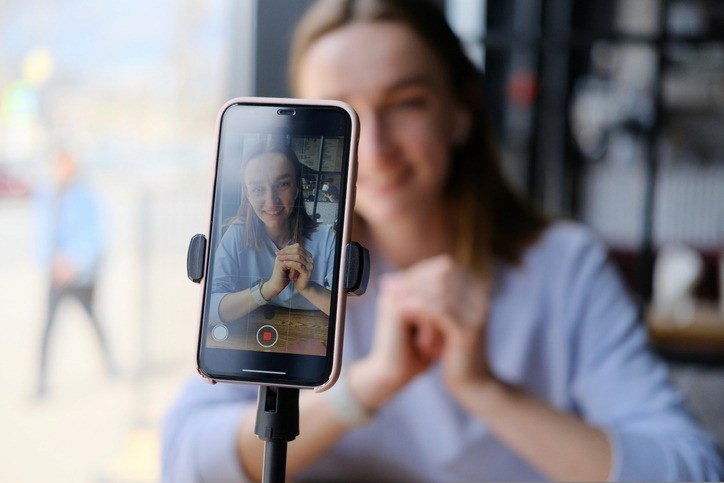
One of the most useful tools is probably already on your phone.
Record yourself during an ordinary meeting, virtual call or your side of a phone conversation when appropriate, then watch or listen to the playback.
Do not focus on whether you like how you look. Observe your behavior.
Ask:
How long does it take me to reach my point?
What happens to my voice under pressure?
Where do I look while speaking?
Do I pause?
Do I interrupt?
Do I listen?
Does my body support my message?
What distracting behavior do I repeat?
Would I experience this person as confident?
Would I experience this person as credible?
Video can expose the distance between intention and perception quickly. It may be uncomfortable, but it is one of the most useful ways to discover what your listeners already experience.
Ask for Feedback You Can Actually Use
“How did I do?”
That question usually produces answers such as “Great,” “Nice job” or “You did well.”
None tells you what to repeat or change.
Ask for behavioral feedback instead:
“Did I get to the recommendation quickly enough?”
“What did you notice about my pace?”
“Did I sound defensive during the Q&A?”
“Where did I lose your attention?”
“Did my body language support my message?”
“What is one behavior I should repeat?”
“What is one behavior I should change?”
The more specific the question, the more useful the feedback can become.
You do not need to accept every opinion as fact. Look for patterns, especially when feedback repeatedly differs from your own perception.
That gap may be telling you something important.
Can Executive Presence Be Learned?
Yes. Executive presence can be developed because the behaviors underneath it can be developed.
You can practice getting to the point, pausing, improving eye connection, reducing distracting movement and strengthening your vocal delivery. You can become more concise, listen better and respond with greater composure under pressure.
None of that requires changing your personality. It requires becoming more intentional about the experience your communication creates.
A Simple Executive Presence Diagnostic
Before your next important interaction, choose one behavior from each category.
Verbal
What is the one point I need my listener to understand?
Vocal
Where will I slow down or pause?
Visual
What behavior will help me stay connected to my listener?
Afterward, review what happened, ask for feedback and record yourself when possible.
Do not try to change ten behaviors at once. Choose one, practice it until it becomes more consistent, then build from there.
That is how executive presence becomes repeatable instead of situational.
Executive Presence Is the Experience You Create
You don't need to become louder or more charismatic, and you don't need to copy someone else's leadership style. You do, however, need to understand how others experience you.
From there, identify which verbal, vocal and visual behaviors strengthen or weaken that experience.
Executive presence is not about performing confidence. It is about communicating in ways that consistently give people a reason to experience confidence in you, one interaction at a time, Monday to Monday®.
Information Alone Will Not Change Your Executive Presence
Knowing what stronger executive presence looks like is useful. Changing how you communicate under pressure is different.
Old habits return quickly when your attention is focused on the customer, board, deadline or decision in front of you.
That is where feedback, deliberate practice and accountability matter.
Stacey Hanke's executive mentoring helps leaders identify the gap between how they believe they communicate and how others experience them, then turn that awareness into observable behavior change.
If stronger executive presence matters to your next level of leadership, start by finding out what your listeners already experience.
Related articles

Why Great Leaders Never Stop Practicing Their Communication Skills
You will never outperform your ability to communicate. If you’re not consistently practicing, you’re consistently slipping.