Influencing Complex Buying Groups: How Sales Professionals Build Confidence, Credibility and Consensus
Stacey Hanke, CPAE Hall of Fame Keynote Speaker and Communications Expert
You finally get the meeting.
The prospect has been difficult to reach. Competition is strong and several other vendors are chasing the same opportunity.
Then you learn who will be in the room.
Procurement.
Finance.
Operations.
The executive sponsor.
A technical expert.
The person who will actually use the solution.
Maybe legal joins halfway through.
Every person is listening for something different, and you have a limited amount of time to prove that you understand what matters to all of them.
That is the reality of complex B2B selling.
Gartner reported in 2025 that B2B buying groups can range from five to 16 people across as many as four functions, and 74% of buyer teams experience unhealthy conflict during the decision process. Gartner also found that buying groups that reach consensus are 2.5 times more likely to report a high-quality deal.
That challenge is bigger than persuading one decision-maker. You are helping a group make sense of competing priorities.
6sense's 2025 research, based on nearly 10,000 B2B buyers studied over three years, found that the average buying group involves about 10 people, buying journeys often last close to a year and many important buying decisions happen before sellers enter the conversation. The research also found that about 40% of buying-group members come from outside the department that will ultimately use the solution.
That means the person you are talking to may not even share the same priorities as the person sitting beside them.
It is not enough to sell.
You have to influence the group.
You have to help people understand your recommendation, trust your judgment and feel confident enough to support the decision when you are no longer there.
Your Competition Is Not Just the Other Vendor
It is every distraction in the room.
Every competing priority.
Every concern one stakeholder has that another one does not.
Every memory of a vendor who overpromised.
Every risk someone is afraid of owning if the decision goes wrong.
Buyers are also doing a significant amount of research before they ever speak with you. 6sense found that 94% of buying groups rank their shortlist before engaging sellers and nearly 80% ultimately buy from the vendor they preferred before that first seller conversation.
That does not make the salesperson irrelevant.
It makes the interaction more important.
You are often entering the conversation during validation.
The buying group is asking:
Do we trust them?
Can they actually deliver?
Do they understand our problem?
Can they explain the solution clearly?
What happens if something goes wrong?
Can we defend this choice internally?
Your communication either gives them confidence in those answers or gives them another reason to hesitate.
Buyers Experience Your Confidence Before They Evaluate Your Slides
Think about what happens when you enter a high-stakes buying-group meeting.
Before you have explained one feature or shown one case study, people have already started forming an impression.
They notice how you walk into the room.
Where you look.
How you sit or stand.
Whether you appear grounded or rushed.
Whether your facial expression suggests confidence, tension or uncertainty.
Your body is communicating before your words have a chance.
An open posture communicates that you are comfortable being there. Purposeful gestures can reinforce a key idea. Facial expressions tell buyers whether your enthusiasm, concern or confidence is genuine.
Fidgeting does the opposite.
Looking repeatedly at your laptop or presentation deck instead of the people in the room can make you appear disconnected.
Crossed arms during a difficult question can communicate defensiveness even when your words say, "That's a fair concern."
Confidence is communicated through pace, pauses, posture, gestures and active listening, not simply through telling yourself to feel confident.
Your buyers experience all of it.
Confidence Does Not Mean Taking Over the Room
Some salespeople hear "show confidence" and assume they need to talk more.
That usually hurts them.
Confidence is not dominating the meeting.
It is being comfortable enough to:
pause before answering
say what you know
say what you do not know
ask a question instead of guessing
let another person finish
listen without immediately defending
stop talking when the point has landed
A nervous seller fills silence.
An influential seller can use it.
If someone asks a difficult question, you do not have to respond the instant the last word leaves their mouth.
Pause.
Look at the person.
Think.
Then answer.
The pause communicates control.
The rushed answer often communicates the opposite.
Credibility Sounds Concise
One of the quickest ways to weaken credibility with a sophisticated buying group is to over-explain.
A buyer asks:
"How long will implementation take?"
You answer for seven minutes.
Now the group is wondering whether the answer is complicated, whether you are avoiding the point or whether you actually know.
The more you talk, the more opportunities you create for the main point to disappear.
Brevity does not mean giving incomplete answers.
It means answering the question first.
Then provide the context they need.
Impact with brevity comes from communicating the main message quickly and supporting it with only the information your listener needs.
Instead of:
"Well, there are a lot of variables that influence implementation and every customer is a little different. Depending on the integrations and the number of teams involved..."
Try:
"Most clients are fully implemented within 90 days. Your timeline could change depending on two things: the number of integrations and how quickly your teams can make decisions."
Now the buyer has an answer.
If they want more detail, they will ask.
Your Knowledge Is Judged by How Clearly You Can Explain It
Complex solutions tempt salespeople to prove expertise by sharing everything they know.
That is rarely what buyers need.
Knowledge does not sound impressive when nobody can follow it.
Your job is to make complexity easier to understand.
If a CFO asks about ROI, answer from the CFO's perspective.
If operations asks how the solution affects workflow, do not give the same answer you gave finance.
If IT asks about implementation risk, talk about implementation risk.
This is where adaptability matters.
You keep the core message consistent while changing the context around what each stakeholder needs.
That ability becomes even more important with a buying group because everyone is listening through a different filter.
Do Not Sell to Six Individuals. Influence One Group.
This is where complex sales get interesting.
A buying group may contain six, 10 or 15 people, but your job is not simply to personalize six different pitches.
In fact, that can backfire.
Gartner found that messages tailored around the relevance of the buying group improved consensus, while individual-level personalization could increase conflict by reinforcing separate stakeholder perspectives.
That means your message needs to help the group understand what they have in common.
Instead of only telling finance why your solution matters to finance and operations why it matters to operations, help everyone see the shared business problem.
For example:
"The CFO is looking at cost. Operations is looking at adoption. IT is looking at implementation risk. All three concerns come back to the same decision: can you implement this without disrupting the business and still produce the return you expect?"
Now you are helping the group connect their different concerns.
That is far more influential than answering each objection in isolation.
Reputation Enters the Room Before You Do
You may be meeting some stakeholders for the first time.
That does not mean they know nothing about you.
They may have:
talked with an existing customer
read your LinkedIn profile
asked a colleague about your company
worked with your organization in a previous role
read reviews
researched your reputation before the meeting
In many complex buying decisions, prior experience plays a major role. 6sense found that buying groups already know most of the vendors they evaluate and that previous experience heavily influences which vendors make the shortlist.
Forrester's 2025 trust research found that coworkers and management inside the buying organization were the most trusted information sources, followed closely by vendors buyers already work with.
That means what people say about you after you leave the room matters.
A lot.
Your reputation is not built only during the formal sales presentation.
It is built when:
you respond when you said you would
your follow-up is concise
your proposal matches what you discussed
you acknowledge a mistake quickly
your email sounds like the person they met
your behavior stays consistent from one meeting to the next
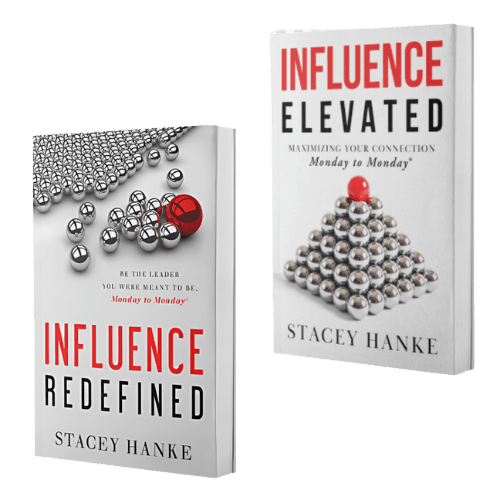
Influence Redefined makes this point directly: your reputation enters the room before you do, and inconsistent behavior causes people to question credibility and trust.
You cannot be exceptionally credible in the pitch and careless in the follow-up.
Influence does not work that way.
Your Message and Delivery Have to Match
Imagine saying:
"We are absolutely confident we can meet that timeline."
while your eyes move away from the group.
Or:
"This is one of our strongest capabilities."
while your voice drops and you begin fidgeting with your pen.
Your words are saying one thing.
Your delivery is saying something else.
Which one do buyers believe?
Usually the behavior.
Stacey's work has long emphasized that influence comes from consistency between what you say and how you say it. Distracting delivery behaviors can make a knowledgeable person appear uncertain, while purposeful posture, gestures, facial expressions and eye connection strengthen the message.
Your buying group should not have to decide which signal to trust.
Expect Challenging Questions
If you are selling something important enough to require a complex buying group, you should expect pressure.
Questions may sound like:
"Why are you more expensive?"
"Why shouldn't we stay with the incumbent?"
"What happens if implementation fails?"
"Your competitor says they can do this faster. Why can't you?"
"We tried something similar three years ago and it failed. Why will this be different?"
"Who takes responsibility if you miss the deadline?"
Those questions are not interruptions to the sales process.
They are the sales process.
Buyers are testing more than your answer.
They are watching how you respond.
Do you become defensive?
Do you ramble?
Do you talk over the person?
Do you immediately blame another team?
Do you attack the competitor?
Or do you stay composed?
How to Handle a Challenging Question Without Losing Credibility
Start by listening to the entire question.
Do not formulate your answer halfway through.
Then pause.
Acknowledge the concern without filling the response with empty phrases such as:
"That's a great question."
or:
"I completely understand."
Get to the answer.
A strong response might sound like:
"Yes, our investment is higher. The difference is implementation support. Your team told us adoption risk is one of your biggest concerns, and our proposal includes 90 days of hands-on implementation support that the lower-cost option does not."
That answer is:
direct
concise
relevant
connected to something the buyer already told you matters
Then stop.
Let the group respond.
Do not destroy a strong answer by adding another three minutes of explanation.
Say "I Don't Know" When You Don't Know
Few things damage credibility faster than pretending.
Buying groups contain experts.
Someone in that room will know when you are bluffing.
If you do not know the answer, say:
"I don't know the answer to that, and I don't want to guess. I'll get the correct information from our technical team and have it to you by 3:00 tomorrow."
Then do it.
That response can build more credibility than an impressive-sounding answer that turns out to be wrong.
Knowledge matters.
Knowing the limit of your knowledge does too.
Read the Group While You Are Selling
A complex buying-group meeting cannot be a memorized presentation.
You need to read the room.
Who is leaning in?
Who looks skeptical?
Who has stopped making eye connection?
Who keeps asking questions about risk?
Who has not spoken?
Who seems to have influence with the other members?
Do not make assumptions about what those behaviors mean.
Ask.
"You've been quiet on this part. What are you thinking?"
"What concern haven't we addressed?"
"Where do you see the biggest implementation risk?"
"What would prevent your team from supporting this?"
These questions do more than uncover objections.
They help the buying group surface issues with each other.
Sometimes the most valuable thing you can do as a seller is help buyers have the conversation they have been avoiding internally.
Stop Presenting Long Enough to Listen
One of the sales examples in Influence Redefined involves a pharmaceutical representative who improved her results when she stopped doing most of the talking and gave physicians more room to explain their needs. She found that listening helped her identify the right solution rather than simply promoting everything she knew.
That principle applies to every complex sale.
You do not influence people by exhausting them with information.
You influence them by understanding what matters enough to say the right thing.
Sales technique will not save an unclear message, distracting behavior or weak reputation.
Stop talking and start learning.
Influence Has to Continue After You Leave the Room
Your meeting may go extremely well.
Everyone smiles.
People thank you.
You leave thinking:
"We nailed it."
Then the buying group meets without you.
That is the moment your influence is really tested.
Can your champion explain your value to procurement?
Can operations answer the CFO's concern?
Can the executive sponsor defend the recommendation when someone says the incumbent feels safer?
Can the group remember what made you different from the four other vendors?
This is what Stacey means by influence beyond the interaction.
Your influence needs to continue when you are no longer physically present.
Before you leave, ask yourself:
What do I want these people saying about us when we are not here?
Then make sure your message is simple enough for them to repeat.
Give the Group Language They Can Use Internally
Do not leave buyers with only your marketing language.
Give them a concise way to explain the decision.
For example:
"The reason organizations choose us is not that we are the cheapest option. It is that we reduce the implementation risk that creates the greatest cost when adoption fails."
That sentence is useful after you leave.
A buyer can repeat it.
Compare that with a slide containing eight capabilities and 14 bullet points.
Which one survives the internal conversation?
Brevity helps your message travel.
Follow-Up Is Part of the Sale
A lot of credibility is lost after the meeting.
The seller promises information by Friday and sends it Monday.
The follow-up email is six paragraphs long.
The proposal introduces language nobody discussed.
A question raised during the meeting disappears.
Every one of those moments communicates something.
Your follow-through tells buyers whether your presentation was performance or reality.
If you say:
"I'll send that by 3:00 tomorrow."
send it by 3:00 tomorrow.
If you cannot, communicate before the deadline.
Consistency builds trust.
True influence is something buyers should experience Monday to Monday®, not only during the big sales pitch.
Your buying group needs to experience the same credible person before, during and after the presentation.
Run This Buying-Group Influence Check
Before your next complex sales conversation, ask:
Confidence
Does my posture communicate that I belong in the room?
Am I making eye connection with everyone, not only my champion?
Are my gestures purposeful?
Do my facial expressions support my message?
Can I pause without appearing uncomfortable?
Credibility and Knowledge
Can I explain our recommendation concisely?
Am I answering the question that was actually asked?
Can I simplify technical information without making it inaccurate?
Am I comfortable saying "I don't know" when necessary?
Adaptability
Do I understand what matters to each function represented?
Can I connect those different concerns to one shared business problem?
Am I watching how people respond and adjusting in real time?
Reputation
Is my communication consistent before, during and after the meeting?
Do I follow through when I say I will?
Would an existing customer describe me the same way this buying group experiences me?
Challenging Questions
Do I listen to the full question?
Can I pause before answering?
Do I respond directly instead of becoming defensive?
Do I stop once I have answered the question?
If several of those answers make you uncomfortable, that is useful information.
Those are the behaviors to practice.
Complex Sales Are Won Beyond the Pitch
Your product matters.
Your price matters.
Your solution matters.
They are rarely the only things being evaluated.
A complex buying group is also deciding whether they trust you enough to recommend your organization when you are not in the room.
They are deciding whether your confidence feels credible, whether your expertise makes the decision easier to understand, whether you listen, whether your answers hold up under pressure and whether your reputation matches the experience you are creating.
Competition is strong.
Attention is limited.
Buyers have more information and more options than ever.
You cannot rely on selling harder.
You have to make it easier for the buying group to understand the decision, trust the recommendation and move together.
That is influence.
Stacey Hanke Inc.'s sales communication training helps sales professionals communicate with greater confidence, credibility and consistency in high-stakes buying conversations. Through feedback, practice and accountability, sellers learn to read the room, communicate with brevity, handle challenging questions and create influence that continues long after the meeting ends.
If your sales team is competing for complex opportunities but struggling to build consensus across multiple stakeholders, explore sales communication training.